Pair Sum – Unsorted
Easy
Given an array of integers, return the indexes of any two numbers that add up to a target. The order of the indexes in the result doesn’t matter. If no pair is found, return an empty array.
Example:
Input: nums = [-1, 3, 4, 2], target = 3
Output: [0, 2]
Explanation: nums[0] + nums[2] = -1 + 4 = 3
Constraints:
- The same index cannot be used twice in the result.
Verify Sudoku Board
Medium
Given a partially completed 9×9 Sudoku board, determine if the current state of the board adheres to the rules of the game:
- Each row and column must contain unique numbers between 1 and 9, or be empty (represented as 0).
- Each of the nine 3×3 subgrids that compose the grid must contain unique numbers between 1 and 9, or be empty.
Note: You are asked to determine whether the current state of the board is valid given these rules, not whether the board is solvable.
Example:
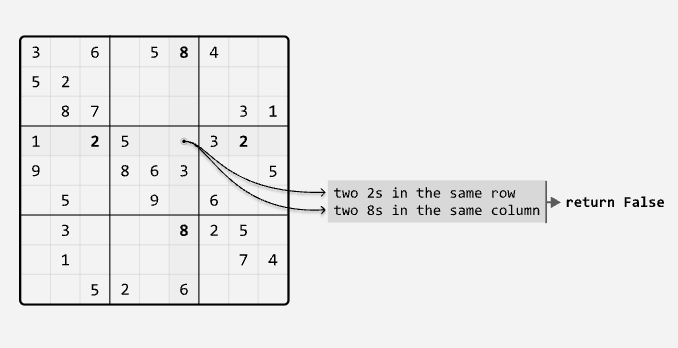
Output: False
Constraints:
- Assume each integer on the board falls in the range of
[0, 9].
Zero Striping
Medium
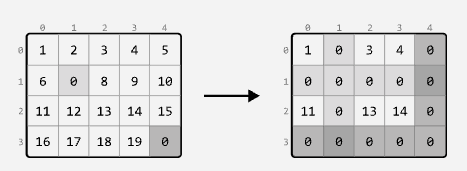
For each zero in an m x n matrix, set its entire row and column to zero in place.
Longest Chain of Consecutive Numbers
Medium
Find the longest chain of consecutive numbers in an*array. Two numbers are consecutive if they have a difference of 1.
Example:
Input: nums = [1, 6, 2, 5, 8, 7, 10, 3]
Output: 4
Explanation: The longest chain of consecutive numbers is 5, 6, 7, 8.
Geometric Sequence Triplets
Medium
A geometric sequence triplet is a sequence of three numbers where each successive number is obtained by multiplying the preceding number by a constant called the common ratio.
Let’s examine three triplets to understand how this works:
- (1, 2, 4): This is a geometric sequence with a ratio of 2 (i.e., [1, 1⋅2 = 2, 2⋅2 = 4]).
- (5, 15, 45): This is a geometric sequence with a ratio of 3 (i.e., [5, 5⋅3 = 15, 15⋅3 = 45]).
- (2, 3, 4): Not a geometric sequence.
Given an array of integers and a common ratio r, find all triplets of indexes (i, j, k) that follow a geometric sequence for i < j < k. It’s possible to encounter duplicate triplets in the array.
Example:
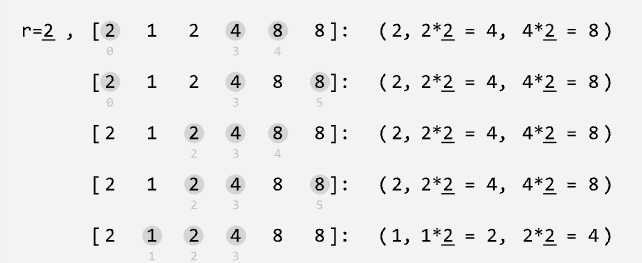
Input: nums = [2, 1, 2, 4, 8, 8], r = 2
Output: 5
Explanation:
- Triplet
[2, 4, 8]occurs at indexes(0, 3, 4),(0, 3, 5),(2, 3, 4),(2, 3, 5). - Triplet
[1, 2, 4]occurs at indexes(1, 2, 3).